
Brave Like Boone: Born With Half a Heart — Now Whole
Emily Buckley
Editor in Cheif
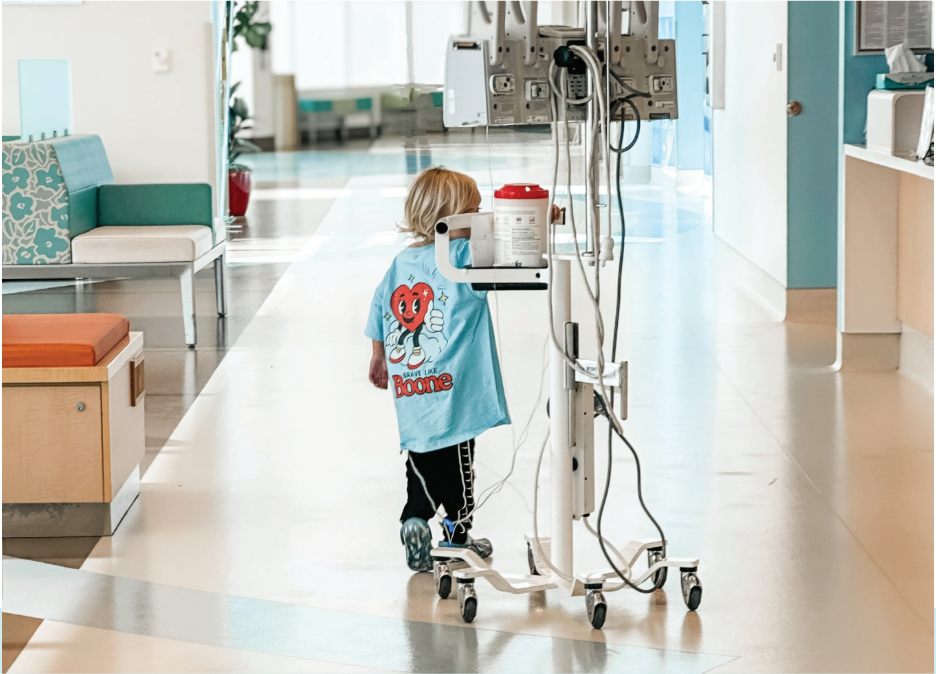
At first glance, Boone Bybee looks like any other 4-year-old boy: bright-eyed, quick to laugh and endlessly in motion. He runs laps through his home now, something his parents, Bailey and Brad Bybee, once wondered if they would ever see. If you met Boone today, you might be surprised to learn about the journey that began long before he took his first breath.
When Bailey was expecting Boone, her third child, she went in for her 20-week ultrasound and received news that changed everything. “We found out that he essentially had half of a heart,” Bailey said. Further testing confirmed the diagnosis: hypoplastic left heart syndrome, or HLHS, a severe congenital heart defect in which the left side of the heart does not fully form.
Doctors laid out three options for Bailey and Brad.
“They actually gave us a choice to terminate the pregnancy, choose not to intervene and let him pass away at birth, or we could choose the surgical route,” Bailey said. “We always knew we were going to choose life for him.” Because Boone would need immediate specialized care, Bailey planned to deliver at the University of Utah in Salt Lake City so Boone could be transported directly to Primary Children’s Hospital. When Bailey went into preterm labor at 32 weeks, she was life-flighted to Salt Lake City and placed on strict bed rest for six weeks.
During that time, their young family was split. Bailey remained in Salt Lake City near the hospital where she would deliver Boone, while Brad stayed home caring for their older children, Baxter (Bax), now 8, and Briar, now 6.
Through diligent bed rest, Bailey was able to carry Boone to 37 weeks gestation, an important milestone to give his already strained heart the best chance at survival. After birth, Bailey and Brad were able to hold their baby boy for just a few minutes before he was whisked away to Primary Children’s Hospital.
Baby Boone was immediately started on medication to keep a hole in his heart open, something that would normally close after birth. “If his would have closed, that’s what would have taken his life,” Bailey said. At just three days old, Boone underwent his first open-heart surgery.
“We were prepared for it,” Bailey said, “but it was still super hard to send him.” That first hospital stay lasted about a month before Boone came home on oxygen and with a feeding tube. His second surgery followed at 4 1/2 months old. The plan had always been a series of three surgeries: two in infancy and a third around age 3.
“They do it in a three-part series,” Bailey said. “If they did it all at once, it would just be too much on his little body.”
But by age 3, Boone’s condition began to worsen.
“He was living at about 15% heart function,” Bailey said. “His heart literally was just barely pumping.” Instead of moving forward with the third surgery, doctors made a difficult call.
“They just didn’t think he would tolerate going through another surgery,” she said. “So, we started to work toward a transplant.”
Last August, Boone’s condition deteriorated further, and he was admitted to the hospital to wait for a heart, a waiting period they were warned could last months or even years, if he could survive that long.
“He waited for a heart for 68 days,” Bailey said. “Most kids his age who are waiting for hearts wait for a year or more.”
As Boone’s condition continued to decline, doctors turned to extraordinary technology to keep him alive: a Berlin Heart, an external heart pump.
“It was another open-heart surgery,” Brad said. “Two big tubes went up into his heart and pretty much took the place of his heart.” Boone was connected to a machine that pumped blood through his body.
Despite the intensity of it all, Boone amazed everyone. “I have videos of him playing baseball with [his Berlin Heart attached],” Bailey said. “From the state he was in before to that, he actually felt better on it.”
When the call came that a donor heart might be available, it came with uncertainty.
“They told us, ‘Don’t have your hopes up too high,’” Brad recalled. Boone was one of several candidates.
What followed were nearly two long days of waiting, blood tests, compatibility checks, and cautious optimism.
“They didn’t tell us it was 100% until they physically saw the heart,” Brad said.
The surgery took hours.
“Those calls are kind of gut-wrenching,” Bailey said. “It could go either way.”
But this time, it went right.
In November, Boone received his new heart. He recovered in the hospital for another 15 days, for a total of 83 days in the hospital before coming home.
The joy of Boone’s transplant came with deep, complex grief.
“One mom’s loss saved another little boy,” Bailey said quietly.
“I didn’t realize how hard it was going to be,” she admitted. “I wasn’t praying for someone’s child to die. But if something inevitable happened, I hoped they would choose to donate.”
The Bybees do not yet know the donor family, but the connection is profound.
“I just want to hug them and say thank you,” Bailey said. “They saved Boone.”
Editor’s Note: Why Organ Donation Matters
Boone’s story is one of courage, faith, medicine, and an extraordinary act of generosity. A heart transplant does not happen without unimaginable loss. Behind every life saved is a family who made a selfless decision to donate in the midst of profound grief.
Across the United States, thousands of children are waiting for life-saving organ transplants. For many, the wait can be one to two years or longer, and not every child survives long enough to receive the gift Boone did. Organ donation is carefully regulated, ethically guided, and handled with deep respect for donor families.
If Boone’s journey has stirred your heart, we encourage you to learn more about organ donation, talk with your loved ones, and consider registering as a donor. One choice can save multiple lives and create stories of hope that ripple through families and communities for generations.
To follow Boone’s ongoing journey, visit @bravelikeboone on Instagram.
Through Boone’s story, shared publicly on Instagram at @bravelikeboone, the family hopes to open hearts and minds about organ donation.
“There are so many kids waiting,” Bailey said. “Sometimes they don’t make it.”
Today, Boone is healthier than he has ever been, but the journey is far from over.
“They say it’s like switching one disease for another,” Bailey said. Boone takes 13 to 14 medications twice a day to suppress his immune system so his body does not reject his new heart. “They’re awful,” she laughed.
He also undergoes frequent procedures to monitor rejection, and infection is a constant concern.
Another reality: Donor hearts typically last 12 to 15 years.
“Someday he’ll need another one,” Bailey said. “That’s hard to think about.”
Still, the difference is undeniable. “He just has more life,” she said. “Before, he was always tired. Now he just runs. He does laps in our house.”
“He feels free,” Brad added. “He never knew that before.”
Boone’s journey has shaped their entire family. “I feel like it’s taught our kids empathy,” Bailey said. “Briar is Boone’s little protector and [both of our older kids] really know how to look out for others.”
For Bailey and Brad, perspective has shifted permanently.
“People will say, ‘We don’t know how you do it,’” Brad said. “You don’t have a choice. You just do it. And we hope we’ve done it as well as we could have.”
Being home together now feels like a miracle.
“Just being together — that’s something we don’t take for granted,” Bailey said.
Boone may carry another child’s heart in his chest, but he carries something else, too: resilience, courage, and a life fiercely chosen.